Understanding grief
What is grief and how does it work?
Grief is a natural response to loss, yet it can be deeply affecting. It touches your thoughts, emotions, body, relationships, and sometimes even your sense of self. You may try to give the loss a place, while still struggling with sadness, fatigue, anger, or confusion.
Grief unfolds differently for everyone and rarely follows a straight path: moments of intense grief may alternate with periods of rest or distraction, and it often demands a great deal of time and energy. While time can ease some of the pain, grief sometimes lasts longer than expected.
Types of loss
When most people think of grief, they first think of the death of a loved one. Yet grief can also arise from other types of loss. Common examples include:
Loss of loved ones
Death of a partner, parent, child, friend or family member
Miscarriage or pregnancy loss
Loss of a pet
Loss in relationships or work
End of a relationship, or a divorce
Loss of job or career - job loss, retirement, or loss of an important role
Loss of health or safety
Living with a loved one who suffers from dementia or a serious illness
Loss of health or mobility
Loss of financial security
Loss of social or personal roles
Loss of social status or independence
Moving, or losing a familiar environment
Unfulfilled hopes, dreams or expectations
Changes in relationships with family or loved ones
Any loss can trigger a grieving process and deserves acknowledgement. Grief is about something that had meaning in your life, not just physical loss.
Coping with loss and grief
There is no universal recipe for grief. Everyone grieves in their own unique way. Sometimes you adapt quickly to the "new" life, but feelings of loss remain present for a long time. Or you thought you had processed the loss, but later you are again overwhelmed by grief.
Know that this is normal, and there is no need to worry. All the emotions and thoughts you experience are part of your personal grieving process. While there are phases or tasks that often recur during grieving, their sequence, intensity, and duration vary from person to person and from situation to situation.
Everything you are experiencing is part of your unique way of grieving. If you would like to explore how professional grief counseling can help you process your loss, feel free to reach out for a free intro session.
Common responses to grief and loss

How loss can affect you
Grief affects more than just your emotions. Loss can be felt on many levels. You might experience sadness and loneliness, as well as fatigue, restlessness, trouble concentrating, or a sense that life no longer feels quite as natural.
Below is an overview of common reactions to grief and loss. It is important to know that all of these responses are normal, and that everyone experiences grief in their own way.
Emotional
sadness and crying
feelings of guilt, relief or shame
anger, helplessness, or irritability
anxiety or insecurity
emptiness or feelings of meaninglessness
Physical
sleep problems or nightmares
headaches or tense muscles
fatigue or exhaustion
decreased appetite or, conversely, eating more
increased tension, agitation or restlessness
Cognitive
ruminating or repeatedly thinking about the loss
problems with concentration
forgetfulness or a “foggy mind”
indecisiveness or difficulty making decisions
difficulty with planning or managing daily tasks
Social
reduced desire for social contact, or conversely, a strong need for support
difficulty connecting with others
withdrawing from activities or work
feeling that those around you don’t understand you
So it is not surprising if you sometimes ask yourself: How do I cope with this? Am I grieving in the 'right' way?
Do you recognize many of these symptoms? That's normal - take them seriously and be gentle with yourself.
Reach out for a free intro session.
Without pressure or obligation.

Exploring grief models
Grief is a personal process and works differently for everyone. Models that many people recognize can offer guidance. They do not provide a fixed roadmap or step-by-step plan, but they can help you understand how emotions and changes may present themselves during grief.
Below are some commonly used, recognizable models of grief. They can help you recognize and understand your own feelings, without implying that there is a “right” way to grieve.
Five to seven stages of grief, Elisabeth Kübler-Ross
-

Five stages of grief
Psychiatrist Elisabeth Kübler-Ross described five common phases that people often experience during grief. She emphasized that grief is a personal and unique process — no one moves through the phases in the same way or in the same order.
The model can help you find recognition, but it is not a set roadmap. Emotions, thoughts and bodily reactions can alternate, overlap or sometimes be skipped altogether.
Denial - "This can't be happening." Sometimes it feels like the loss isn’t real or hasn’t fully sunk in yet.
Anger - feelings of frustration, anger, resentment or resistance. You may find yourself wondering why this happened to you.
Bargaining - thoughts such as "If I had done this, maybe it would have gone differently" or "If I change something, I might be able to reverse the loss."
Grief/depression - intense sense of loss, sadness, heaviness, moments of deep silence.
Acceptance - gradually making space for the new reality, new plans, and new possibilities.
These stages rarely follow a straight line. You may move back and forth between stages, skip some, or experience them simultaneously. The model provides recognition, not a fixed roadmap.
-
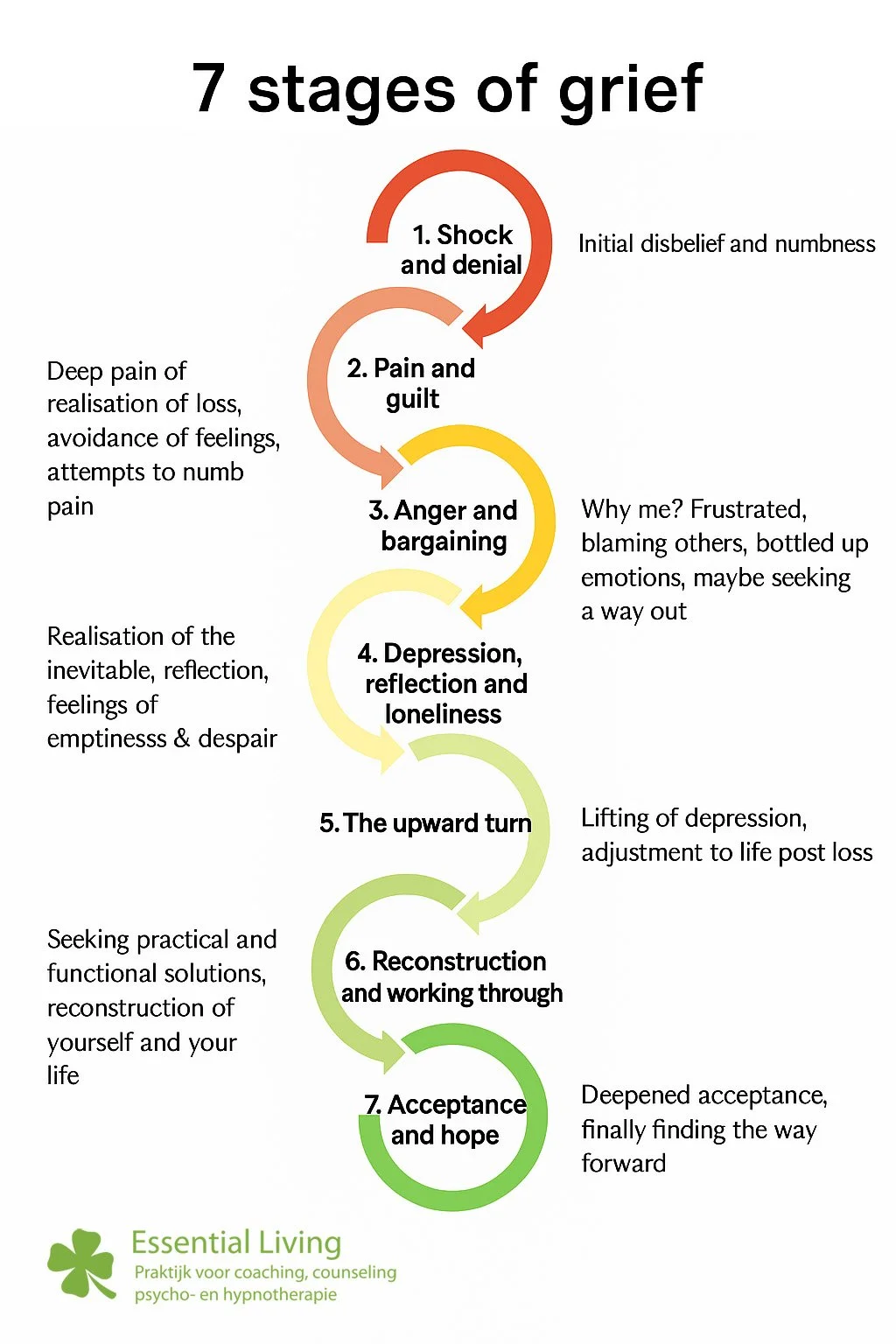
Seven stages of grief
In later versions, the classic grief model has been expanded to seven stages to add extra nuance, such as moments of shock or recovery. A widely used variant in popular grief literature identifies the following seven stages:
Shock & Denial - the loss has barely registered; it may feel unreal.
Pain & Guilt - intense grief and sometimes feelings of guilt about what did or didn’t happen.
Anger & Bargaining - feelings of anger, frustration, or thoughts of undoing the loss.
Grief & Depression - deep sadness, emptiness, and sense of loss.
Reflection & The Upward Turn - moments of insight, recovery, and trying out new possibilities.
Rebuilding & Reconstruction - slowly picking up life again and making new plans.
Acceptance & Hope - creating space for the new reality, with a renewed sense of perspective.
Not everyone moves through these phases in a set order. Some phases occur simultaneously, are skipped, or keep returning. The model offers recognition and insight, not a fixed roadmap.
The Dual Process Model by Stroebe & Schut

The Dual Process Model, developed by psychologists Margaret Stroebe and Henk Schut, explains how people in grief continuously shift between two ways of coping with loss:
Loss-oriented - your attention turns to what or whom you have lost. You reflect on memories, emotions, and the pain of the absence.
Restoration-oriented - you focus on picking up life again, seek distraction, or adapt to new circumstances.
This moving back and forth is quite normal. One day sadness may be overwhelming, the next day you may be more focused on daily matters or small moments of relief or joy. Both sides are important: the loss-oriented side helps you feel and acknowledge the grief, while the restoration-oriented side gives space to continue living.
The model shows that grief is not linear. You don't need to be "dealing with grief" all the time, nor do you need to be strong or forward-looking at every moment. It is the alternation that helps you find your way, step by step.
Growing Around Grief: the model by Lois Tonkin

Growing around grief
Psychologist Lois Tonkin demonstrated that grief does not necessarily get smaller, instead, your life around it grows bigger. The loss remains part of your life, but you learn to live with it. You grow around the grief and find new ways to experience meaning – without without forgetting.
"What we once enjoyed and deeply loved we can never lose, for all that we love deeply becomes part of us."
- Helen Keller

Your process
Whether you recognize yourself in the stages of grief, in the back-and-forth of the dual process model, or in the idea of growing around the loss: your way of grieving is unique.
Models can offer guidance and recognition, but there is no fixed order or “right” way to grieve. Sometimes you feel intense grief, sometimes you resume daily life, and sometimes new meaning and energy slowly grow around the loss. What matters most is that you find your own path, in your own time, and in your own way.
"Those we love don't go away. They walk beside us every day. Unseen, unheard, but always near. Still loved, still missed, and very dear."
- Author unknown

Stuck grief
Feeling stuck or overwhelmed? Grief therapy helps you process complex loss at your own pace. Everyone grieves in their own way, but you don’t have to do it alone. Professional grief support can help you manage your emotions, process the loss, and create space for life again. It provides guidance, insight, and practical tools.
When to seek professional help with grief?
Grieving is a natural process, but sometimes it can get stuck. It may feel as if time is passing, but the grief isn’t lessening, or you feel like you are not moving forward. You might also experience persistent physical symptoms, tension, or sleep problems.
Grief therapy can help you understand what’s happening and what you need to regain direction, meaning, and connection. Seeking support does not mean that you are “not grieving well” — it’s a way to allow yourself guidance through this difficult process. Grief therapy may be appropriate when:
your sadness or feelings of loss interfere with daily functioning
feelings of emptiness, sadness, or guilt continue to prevail
you are struggling to reconnect with life
you feel stuck in your grieving process
grief is affecting your relationships or your social contacts
Feel free to reach out for an intro session. Together we’ll explore what you need and how I can support you.

Complex grief
Sometimes grief remains so intense or prolonged that it interferes with your daily life. This is called complex grief. The grief doesn’t seem to lessen, the sense of loss feels overwhelming, and life can lose its meaning without what or whom you have lost.
Complex grief goes beyond the natural grieving process and often lasts longer than six to twelve months without noticeable relief. It is not a sign of weakness, but a human and often normal response to a profound loss. It shows how much the person or situation meant to you.
Complex grief can manifest in a variety of ways, such as:
Intense grief, months or years after the loss
Difficulty accepting the reality of the loss
Feelings of emptiness or meaninglessness
Difficulty with daily functioning (work, social, self-care)
Pressure on relationships with family or friends
Symptoms resembling depression or trauma
Physical symptoms, sleep problems, fatigue or tension
Professional grief therapÿ can help you give your grief a safe place, gradually reconnect with life, and restore your resilience. You receive support in processing your emotions, finding new meaning and energy, and creating space both to grieve and to look ahead — rebuilding balance in a way that truly suits you.
Reach out for a free intro session.
Without pressure or obligation.